One of the neat additions to this season’s preseason was a coaching parameter that measured a coach’s value beyond what is captured in the preseason ratings. I’ve talked about this over the years, but there are two main aspects of being a head coach: talent acquisition and then coaching that talent.
The two things are undoubtedly correlated, just as a team’s offense and defense are correlated. If you tell me a team has a great offense, they probably also have at least a very good defense, and vice versa. If you tell me a coach is great at bringing in talent, they’re also probably very good at coaching that talent. Otherwise, it would be difficult to convince the talent to play for them.
But there have to be exceptions to this. Just as some teams have a great offense and an average defense, some coaches are great recruiters but average at developing talent (or vice versa). The coaching aspect of the preseason ratings tries to measure the talent development aspect. Everything else in the preseason ratings tries to measure the talent acquisition aspect. Admittedly, the latter is imperfect, but seemingly in the ballpark for most teams, even in the transfer era.
Mostly, you can compare a coach’s performance against past preseason ratings to figure this out, but there are a couple of twists. 1) Preseason ratings only go back to 2012. 2) The algorithm is actually creating its own preseason ratings for each season going back to 2008. Even for seasons since 2012, it is recreating a preseason rating using the current algorithm and the additional data available to train the model.
The list I presented on bluesky was from a training sample and was missing some seasons, but this list includes all seasons from 2008 to 2025:
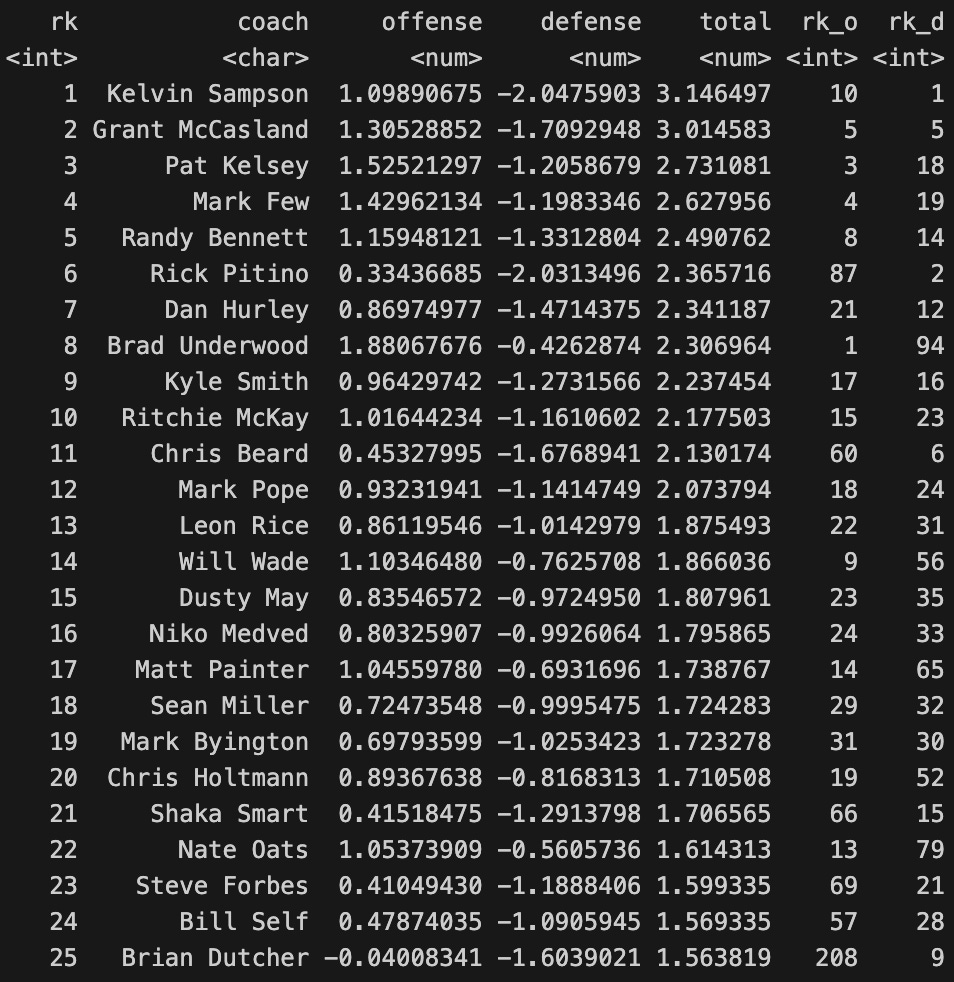
There are naturally questions about why some legendary coaches are missing from the list. But it gets back to performing against preseason ratings. Tom Izzo, for instance, does not have a stellar track record in this regard. It’s fine - above average for sure - but there have also been misses over the years.
For coaches with less experience, there’s another issue. Like the preseason ratings themselves (and the offensive and defensive ratings once the season starts), the coaching ratings are designed to be predictive. They’re trying to answer the question: If we had to guess how much a coach adds to the talent he has brought in, what would it be?
In Ben McCollum’s first D-I season, Drake improved its preseason rating by a whopping 12.40 points. If we assumed that was his coaching effect, Iowa would be rated 6th this season. And while that’s not completely outside the range of possibilities, it would be analytical malpractice to say that’s the expected outcome for Iowa.
So the model is highly skeptical of a single season as an indicator of coaching ability. Which makes sense. While we’d like to attribute all of the improvement of team from their preseason expectations to coaching, it’s often not. Injury luck is an obvious issue, but even just a team gelling or not can be the result of random forces that a coach might be able to predict, but not as well as they might think, I’d guess.
Izzo’s career really exemplifies this. In 2017, he went from preseason #14 to finishing #40. In 2022, he went from preseason #22 to #42. Was he a worse coach in those years than he’s been in years where he’s taken similar rosters to great success? I’m skeptical, and so is the model. Well, the model assumes that coach has one rating for all seasons, so it’s really skeptical.
It’s also skeptical because the preseason ratings are an imperfect measure of talent. To some extent, McCollum gamed the system last year by importing many players with no D-I experience. The preseason ratings assumed these guys were replacement-level MVC players, which they clearly weren’t. That’s something that won’t happen this season, and the model naturally regresses the coaches ratings towards zero in part because of this.
That’s also part of the reason why Randy Bennett is fifth on our list. I do think he’s above average in talent development, but because he regularly brings in unrated players from Australia who are able to contribute immediately (or at least, after redshirting), the model is going to rate his work highly.
Because of the regression aspect, it’s somewhat instructive to look at coaches with similar experience. For instance, here are the ratings for all of the second-year coaches heading into this season:
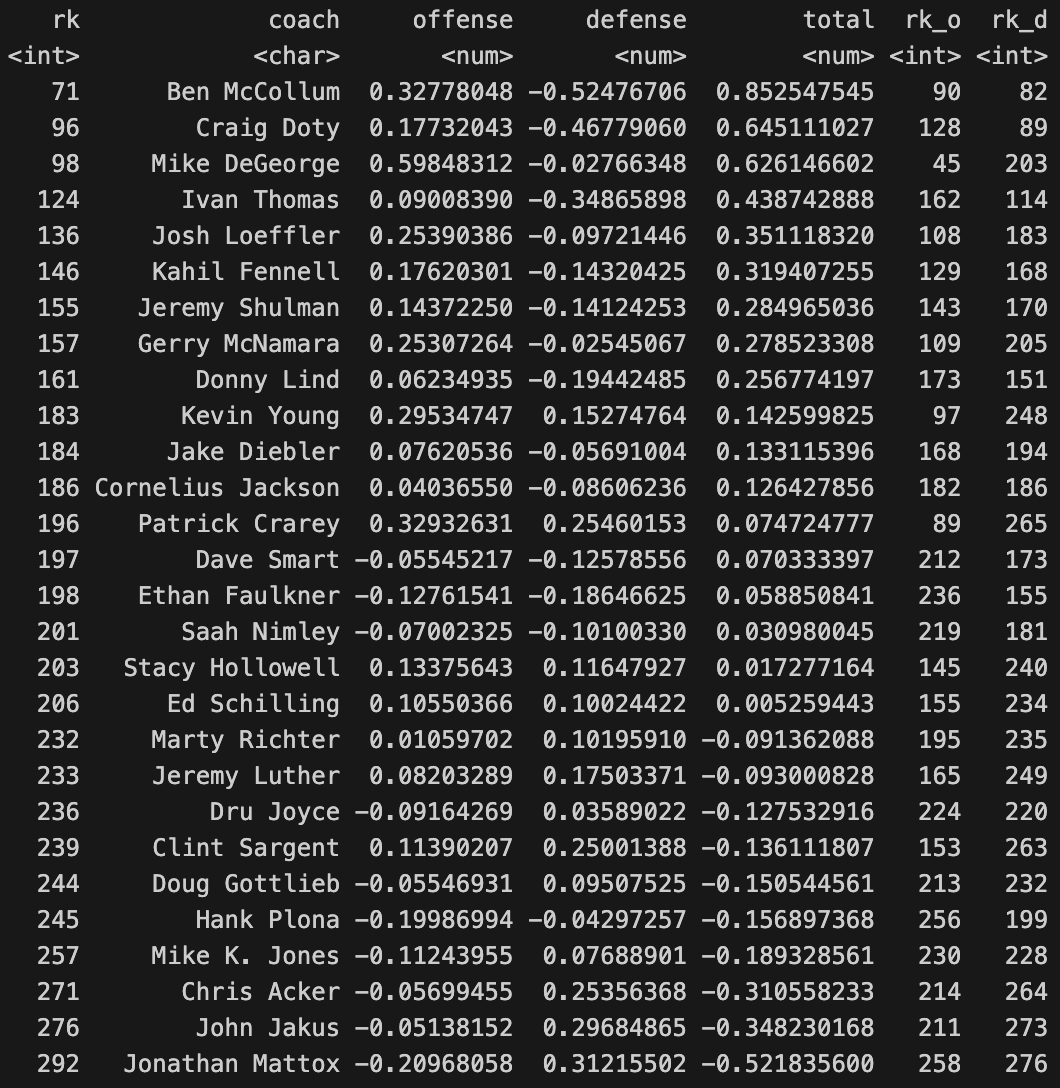
With a full career, one can exceed a rating of +3, but with one season, you really can’t get over +1. In the case of McCollum, Craig Doty, and Mike DeGeorge, they all have extensive experience outside of D-I that might give a human more confidence their rookie season wasn’t a fluke. But alas, the computer doesn’t consider this information.
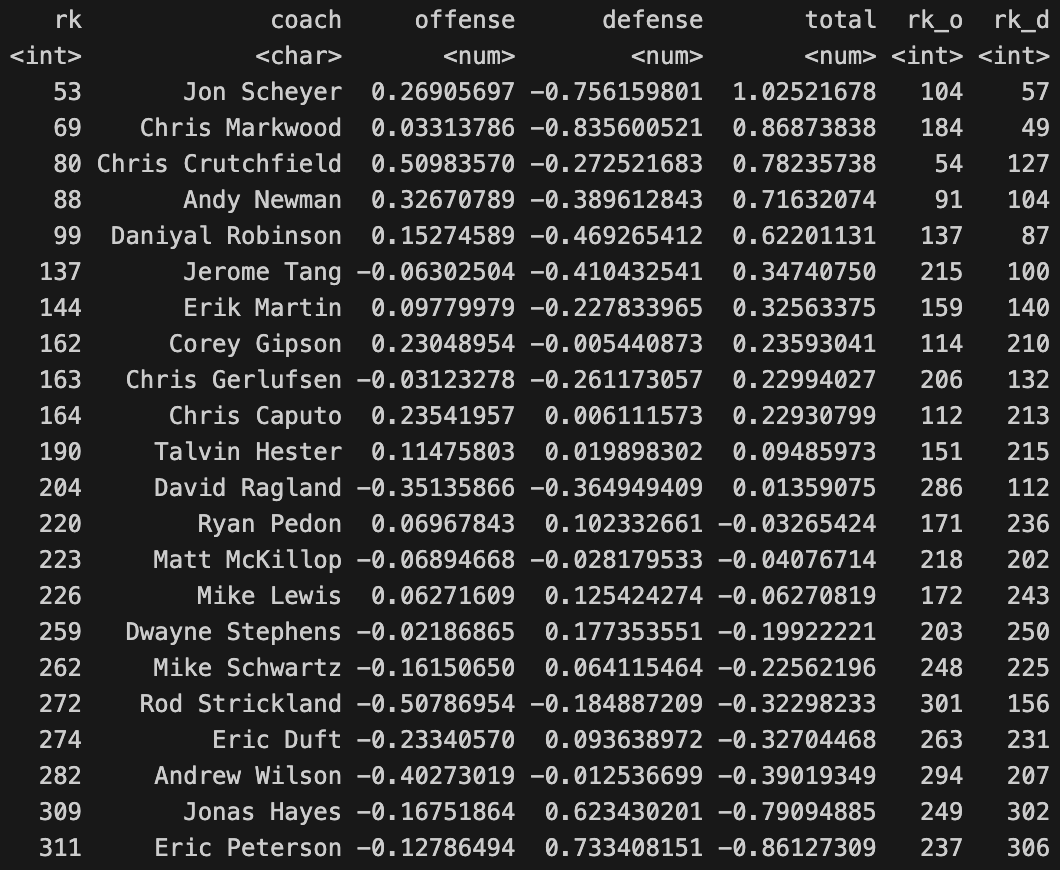
Here’s the list of fourth-year head coaches. This is where you’ll find Jon Scheyer. Last year was pretty amazing, but his first two seasons were nothing special relative to preseason expectations.
One other useful thing we can do is split things up by offense and defense. Let’s start with the offensive value-adds.
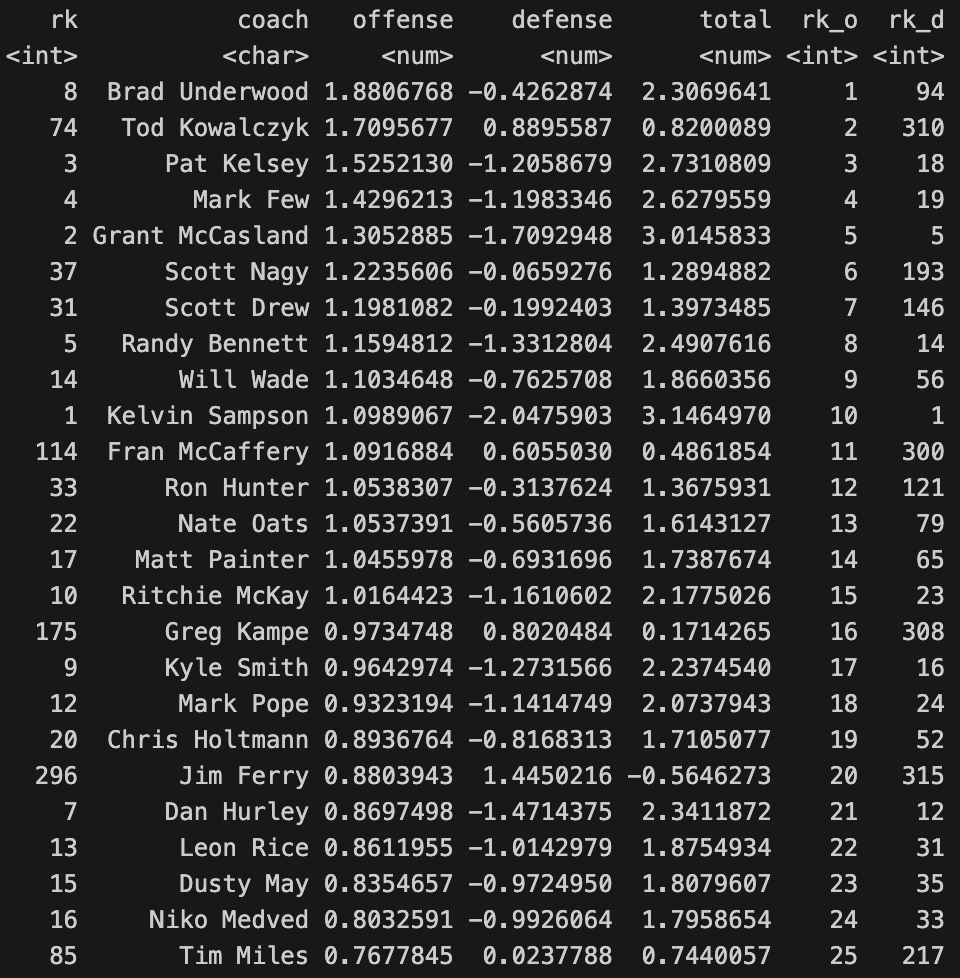
The model assumes that a team with a massive imbalance between offense and defense will see than imbalance shrink the following season. And it’s a good assumption in most cases. But some coaches are resistant to this and Tod Kowalczyk may be the GOAT in that respect.
Here are the model’s top defensive ratings for coaches:
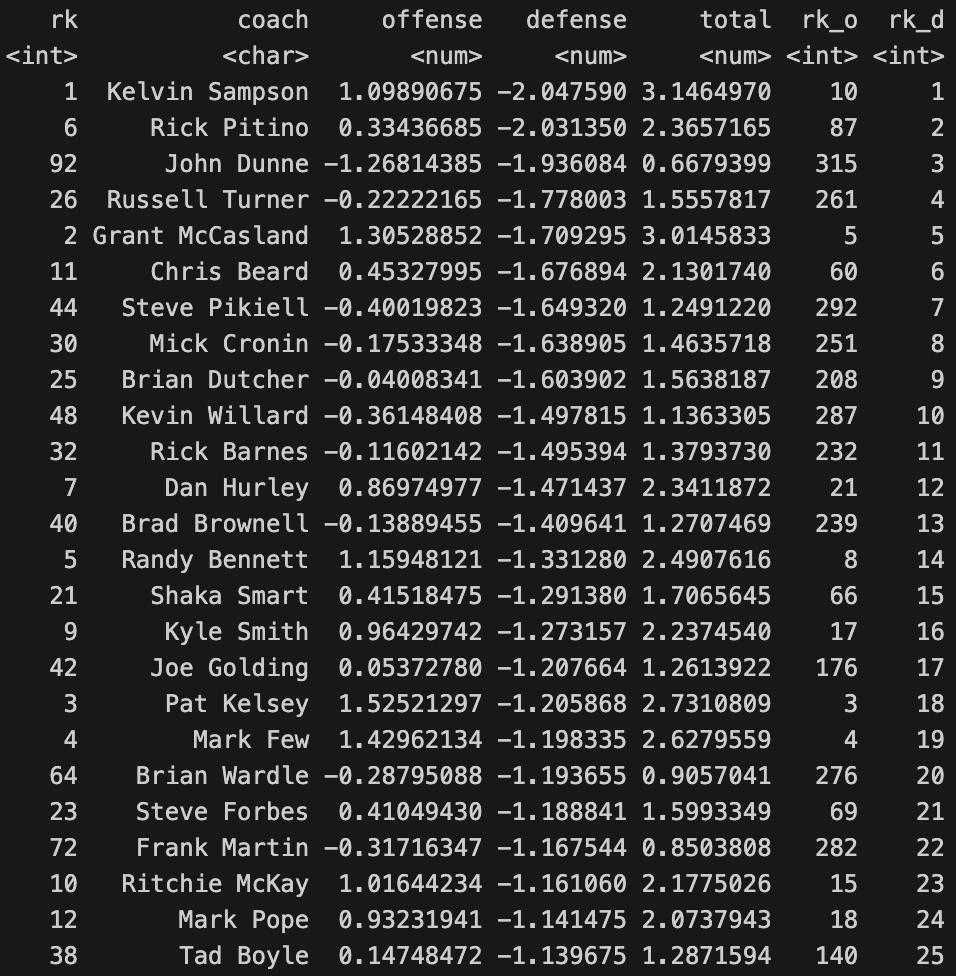
If it was 2005, I’d write a 2000 word opus on John Dunne, but instead I’ll just link to his incredible coaching page. In 19 seasons in the MAAC, his teams have usually been somewhere in the middle of the standings, which is what happens when you have a singleminded focus on defense. In a perfect world, Tod Kowalczyk would be making Dunne an offer to be an assistant.
A conference typically ends with an overall range of 20-30 points of net rating from the best to worst team, while the range of coaching ratings in a league is something like 2-4. This strikes me as a reasonable contrast. Acquiring talent is overwhelmingly more important than coaching that talent, but at the extremes the coaching part can make the difference between winning a championships and finishing third or fourth in a league.
Random ratings note:
One random note from the ratings is that McCollum’s Iowa team is rated as the slowest-paced team to start the season. Like the coaching ratings, the tempo ratings tend to regress towards average, especially for newer coaches. So why is the model rating Iowa as the slowest team?
Well, it is regressing McCollum’s rating. Last season’s Drake team was 8.1 possessions per 40 below the national average, and Iowa is only rated 5.6 below the national average. But the other thing is there’s no obvious frontrunner for the slow-paced crown these days. Tony Bennett and Ron Sanchez are off the scene, and 9-time(!!) slow-poke champ Joe Scott is no longer as militant about taking shots with single-digits on the shot clock as he was in the aughts. Plus, tempo ratings are pretty stable. Unlike the offensive and defensive coaching ratings, one season is rarely a fluke.
Ratings updates:
The ratings have been updated to reflect a handful of recent roster updates, which are mostly due to random players vanishing or obscure transfers I missed. Most of these cases range from irrelevant to minuscule when it comes to their impact on the ratings, but we neglected to include Western Kentucky’s Terrion Murdix in the ratings calculation which bumps up WKU’s rating significantly.
Finally, we have taken the unprecedented step of declaring Wagner’s coach to be “Unknown” at this time. Donald Copeland is still on suspension, no interim coach has been named and the link to the coaching staff on Wagner’s page has shown a 404 error for weeks, so this step seems appropriate. This knocks down Wagner’s rank from 356 to 358, which isn’t bad, really. Maybe playing without a coach will be the wave of the future for a program looking to save a few bucks.